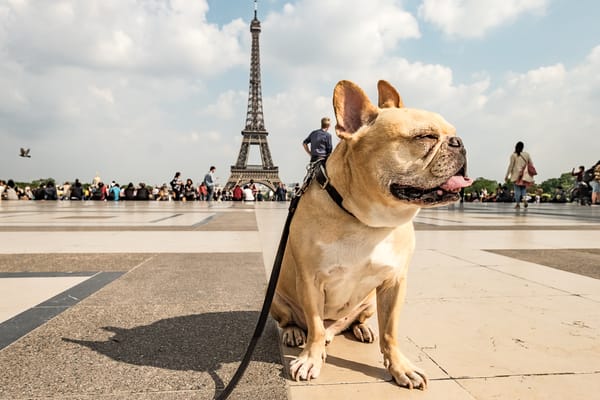
Essential Info: Dog Ownership in Paris
A general overview of the rules and regulations all dog owners living in Paris should know.


All pets must be imported officially into France if they will remain in the territory longer than 3 months.
Importing your Pet
Pets staying in France for more than three months must be officially imported and have their microchips registered in the national database (ICAD - Identification des Carnivores Domestiques).
- This applies to all pets with a microchip requirement; dogs, cats, ferrets.
- If your pet has an EU passport, you still have to go through this process.
- In order to start the process, you must have a French address.
- Visit a veterinarian and explain that you moved to France and wish to register your pet with ICAD. Bring your pet with you along with any helpful documentation such as; pet passport, pedigree papers, or past import / export certificates.
- The veterinarian will enter your previous overseas address and new French address into their system. NOTE: If your pet was imported from a third country before your country of origin, you will need to state the name of the seller along with the export veterinarian or government institute.
- The veterinarian will give you a printed slip for the ICAD registration.
- You must send the printed slip for the registration to ICAD along with payment for the registration, which costs €11 per animal (for some strange reason, they only accept French checks).
- You will receive a receipt in the mail from ICAD to your French address, confirming that your payment has been received and the pet has been successfully registered.
Rental Laws in Paris
If you’re renting a long-term apartment in Paris, you are legally allowed to live there with a pet. This applies to common household animals like dogs, cats, birds, and small pets.
There are a few important exceptions, though; Short-term furnished rentals (think vacation rentals or very short corporate stays) can legally refuse pets. And certain dog breeds classified as “dangerous” under French law (Category 1 and 2 dogs, such as Rottweilers or Staffies) may be restricted.
- Be aware of any regulations or by-laws regarding noise regulation or quiet hours and nuisance prevention for your apartment or rental home.
- Remember to always clean up after your pet when going on walks or you could face hefty fines!
- Pet health insurance is optional, but civil liability coverage is typically included in French home insurance.
Rules regarding "Dangerous Dogs"
Some dogs, considered to be potentially dangerous, are subject to specific regulations. In France, these dogs are classified as 2 categories : attack dog and guard and defense dog. If you keep a dog belonging to one of these categories, you are subject to certain obligations (detention permit, behavioral evaluation of the animal, specific conditions of access of the animal to public spaces, etc.).
- The attack dogs, of 1st category, are dogs from crosses morphologically similar to dogs of the following breeds:
- American Staffordshire terrier (commonly known as pit bulls)
- Mastiff (commonly known as boerbulls)
- Tosa.
- Dogs of 1st category have no pedigree. They are banned from public transport and public spaces. They must be sterilized and are prohibited to be owned by minors or individuals with a criminal record.
- The guard and defense dogs, said of 2nd category, are the dogs of the following breeds :
- American Staffordshire terrier
- Rottweiler
- Tosa.
- They are allowed in France, but are strictly regulated. They must be muzzled and kept on a leash by an adult in public spaces, public buildings, and on public transport.
- If you own a Category 2 dog (or a mixed dog determined by a vet to fall into this category), you must secure a formal ownership permit (permis de détention) from your local town hall.
- The application requires:
- Proof of identification (microchip) and a valid rabies vaccination.
- Third-party civil liability insurance specifically covering the animal.
- A certificate of aptitude (attestation d'aptitude) obtained after completing a 7-hour training course with an accredited French trainer.
- A behavioral assessment of the dog conducted by an approved French veterinarian.
- The application requires:
- Additional requirements for public spaces include:
- Behavioral evaluation
- Mandatory liability insurance
- Muzzle and leash in public
Pets in Public Spaces
Paris is gradually becoming a more dog-friendly city as a whole in recent years. Many green spaces and public parks have become dog friendly, but look out for any and all signage detailing where dogs are and are not allowed.
- All dogs must be kept on a leash in public!
- There are dedicated off-leash and enclosed dog areas in select locations.
- Pets that can fit in a carrier can ride the Parisian regional trains, metro and buses for free!
- Dogs which do not fit into a carrier require the purchase of a dog ticket and must be leashed and muzzled.
- Dogs which do not fit into a carrier are not allowed on buses.
There is no national law banning dogs from cafés, bars, or restaurants in France. Entry is at the discretion of the owner. Most of Paris's bistros, cafes and restaurants are pet friendly, but asking before you bring your furry friend in is generally regarded as a good idea.
- Small boutiques, shops and bakeries generally will allow well behaved pets inside with permission.
- Supermarkets and department stores are a no go unless your pet is a service animal.
If you find yourself moving or traveling to Paris with your pet in the future; be sure to check out our curated list of emergency veterinarian services located throughout the Parisian Metro!